Design Thinking Basics: Process, Principles and Mindset
For newcomers who want a clear picture of what design thinking is and how its process works. You will be able to describe its stages and use simple tests to judge ideas.
7 videos · 71 min
What you’ll learn
✓Explain the five design thinking stages and how the Double Diamond fits
✓Tell problem space from solution space and phrase a challenge as how-might-we
✓Check any idea against desirability, feasibility and viability
✓Apply everyday habits like close observation, assumption-testing and small tests
✓Judge when design thinking suits a problem and when it does not
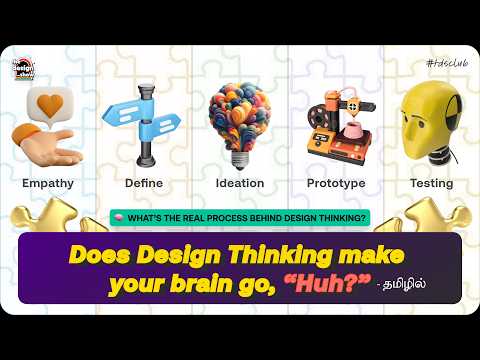
A beginner-level walkthrough of the five phases of design thinking: empathize, define, ideate, prototype and test. It explains the research techniques, problem statements, brainstorming and prototyping and testing methods behind each phase, delivered in Tamil.
An introduction to the design thinking process and the Double Diamond framework, covering how to identify user problems, generate ideas and create solutions to real-world challenges.
A short talk on six design thinking principles: observing closely, immersing yourself in an experience, challenging assumptions, involving other people, running small incremental tests and accepting failure. It is aimed at people in any job, not only designers.
A foundations lesson from the Iris: The Psychology of Design course covering design thinking as a mindset, the Double Diamond's diverge-and-converge rhythm, problem versus solution space, how-might-we questions and Lean UX, applied to a product timeline.
The video introduces the three principles of design thinking: human desirability, technical feasibility and business viability. It explains why good innovation sits where all three overlap, and it is aimed at product managers, entrepreneurs and designers.
Introduces the fundamentals of Design Thinking, covering what it is and is not, the five-stage model, the conditions for when to use it, and how it compares with lean, critical and creative thinking. Aimed at students, managers and innovation professionals as well as designers.
Explains what the word 'design' means in 'design thinking', what the term is meant to convey, a brief history, and why facilitating design thinking is not limited to designers. It is aimed at people new to the term, including workshop participants and facilitators.
For beginners in UI and UX who want to understand how design projects are structured. By the end you will be able to explain the main process frameworks and take a first project from a written brief through to low-fidelity wireframes.
For beginners who want to understand design thinking and its five stages. You will be able to explain the approach and apply first techniques for empathising, defining and ideating.
;}.cls-2{fill:%2358d687;}.cls-3{fill:url(%23Degradado_sin_nombre_10);}.cls-4{fill:url(%23Degradado_sin_nombre_31);}.cls-5{fill:%238030d1;}.cls-6{fill:url(%23Degradado_sin_nombre_23);}%3c/style%3e%3clinearGradient%20id='Degradado_sin_nombre_17'%20x1='129.39'%20y1='83.35'%20x2='56.4'%20y2='162.54'%20gradientUnits='userSpaceOnUse'%3e%3cstop%20offset='0'%20stop-color='%23287d8c'/%3e%3cstop%20offset='1'%20stop-color='%2350b5db'/%3e%3c/linearGradient%3e%3clinearGradient%20id='Degradado_sin_nombre_10'%20x1='449.01'%20y1='190.97'%20x2='266.02'%20y2='78.2'%20gradientUnits='userSpaceOnUse'%3e%3cstop%20offset='0'%20stop-color='%23ffe286'/%3e%3cstop%20offset='1'%20stop-color='%23ffcd1d'/%3e%3c/linearGradient%3e%3clinearGradient%20id='Degradado_sin_nombre_31'%20x1='99.7'%20y1='309.69'%20x2='146.19'%20y2='485.35'%20gradientUnits='userSpaceOnUse'%3e%3cstop%20offset='0.01'%20stop-color='%23ff9464'/%3e%3cstop%20offset='1'%20stop-color='%23b3553a'/%3e%3c/linearGradient%3e%3clinearGradient%20id='Degradado_sin_nombre_23'%20x1='547.05'%20y1='208.96'%20x2='252.56'%20y2='438.86'%20gradientUnits='userSpaceOnUse'%3e%3cstop%20offset='0'%20stop-color='%23ff7da1'/%3e%3cstop%20offset='1'%20stop-color='%23f20b4f'/%3e%3c/linearGradient%3e%3c/defs%3e%3ctitle%3efavicon%3c/title%3e%3cg%20id='_Group_'%20data-name='<Group>'%3e%3cg%20id='_Group_2'%20data-name='<Group>'%3e%3cg%20id='_Group_3'%20data-name='<Group>'%3e%3cpath%20id='_Path_'%20data-name='<Path>'%20class='cls-1'%20d='M232.54,165.43a124.47,124.47,0,0,1-106.95,60.76h0A101.77,101.77,0,0,1,23.82,124.41V0L132.31,95.94A517.46,517.46,0,0,0,232.54,165.43Z'/%3e%3cpath%20id='_Path_2'%20data-name='<Path>'%20class='cls-2'%20d='M250,0V101.78a123.87,123.87,0,0,1-17.46,63.65A517.46,517.46,0,0,1,132.31,95.94L23.82,0Z'/%3e%3cpath%20id='_Path_3'%20data-name='<Path>'%20class='cls-3'%20d='M476.18,226.19a518.87,518.87,0,0,1-243.64-60.76A123.87,123.87,0,0,0,250,101.78V0A226.12,226.12,0,0,1,476.18,226.19Z'/%3e%3cpath%20id='_Path_4'%20data-name='<Path>'%20class='cls-4'%20d='M232.54,334.57a517.71,517.71,0,0,0-100.23,69.54L23.82,500V375.59A101.77,101.77,0,0,1,125.59,273.81h0A124.47,124.47,0,0,1,232.54,334.57Z'/%3e%3cpath%20id='_Path_5'%20data-name='<Path>'%20class='cls-5'%20d='M250,398.22V500H23.82l108.49-95.89a517.71,517.71,0,0,1,100.23-69.54A123.87,123.87,0,0,1,250,398.22Z'/%3e%3cpath%20id='_Path_6'%20data-name='<Path>'%20class='cls-6'%20d='M476.18,273.81A226.12,226.12,0,0,1,250,500V398.22a123.87,123.87,0,0,0-17.46-63.65A518.87,518.87,0,0,1,476.18,273.81Z'/%3e%3c/g%3e%3c/g%3e%3c/g%3e%3c/svg%3e)