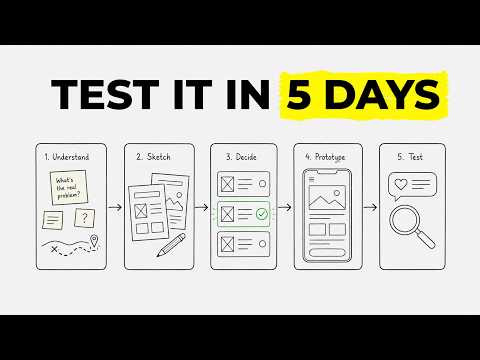
For people new to product design who want to know what a design sprint is, how its days fit together, and whether it suits their problem. By the end you will be able to explain the method and judge when a sprint is worth running.
7 videos · 85 min
What you’ll learn
✓Explain what a design sprint is and the main stages of the process
✓Describe how a sprint tests an idea with users before building it
✓Compare the classic five-day sprint with the four-day Design Sprint 2.0
✓Judge whether a design sprint suits a given problem or team
✓Identify the questions a sprint is well suited to answer
This video introduces the Google Design Sprint, a five-day framework for testing a risky idea quickly with users before committing to full development. It walks through the days Understand, Sketch, Decide, Prototype and Test, and the possible outcomes.
A talk on the design sprint process, presented as a way for product teams to compress debate and test an idea with a realistic prototype before committing to launch. The description suggests it is aimed at designers, product managers and product owners who want to adopt sprints.
Explains AJ&Smart's modified 4-day Design Sprint 2.0 compared with the original five-day Google Ventures format, with a summary of the sprint exercises and tips for simplifying the process.
If you are facing a big problem with an unknown solution and you have a cross disciplinary team to work on it, the Design Sprint methodology is a perfect fit to find and validate a solution in less than a week. We’ve used it several times in the last years, introducing it into our agile processes.
Explains when a team should run a design sprint and what kinds of questions are appropriate to answer with one. Aimed at people who already understand what a design sprint is and need to decide whether to run one.
Explains the difference between the classic five-day design sprint from Jake Knapp's book Sprint and the four-day variant, sometimes called Design Sprint 2.0. The description is brief, so the comparison may be surface-level.
For intermediate facilitators who want to run design sprints more confidently. You will be able to keep sessions on time, lead creative exercises, set up remote boards and plan timing across a sprint.
;}.cls-2{fill:%2358d687;}.cls-3{fill:url(%23Degradado_sin_nombre_10);}.cls-4{fill:url(%23Degradado_sin_nombre_31);}.cls-5{fill:%238030d1;}.cls-6{fill:url(%23Degradado_sin_nombre_23);}%3c/style%3e%3clinearGradient%20id='Degradado_sin_nombre_17'%20x1='129.39'%20y1='83.35'%20x2='56.4'%20y2='162.54'%20gradientUnits='userSpaceOnUse'%3e%3cstop%20offset='0'%20stop-color='%23287d8c'/%3e%3cstop%20offset='1'%20stop-color='%2350b5db'/%3e%3c/linearGradient%3e%3clinearGradient%20id='Degradado_sin_nombre_10'%20x1='449.01'%20y1='190.97'%20x2='266.02'%20y2='78.2'%20gradientUnits='userSpaceOnUse'%3e%3cstop%20offset='0'%20stop-color='%23ffe286'/%3e%3cstop%20offset='1'%20stop-color='%23ffcd1d'/%3e%3c/linearGradient%3e%3clinearGradient%20id='Degradado_sin_nombre_31'%20x1='99.7'%20y1='309.69'%20x2='146.19'%20y2='485.35'%20gradientUnits='userSpaceOnUse'%3e%3cstop%20offset='0.01'%20stop-color='%23ff9464'/%3e%3cstop%20offset='1'%20stop-color='%23b3553a'/%3e%3c/linearGradient%3e%3clinearGradient%20id='Degradado_sin_nombre_23'%20x1='547.05'%20y1='208.96'%20x2='252.56'%20y2='438.86'%20gradientUnits='userSpaceOnUse'%3e%3cstop%20offset='0'%20stop-color='%23ff7da1'/%3e%3cstop%20offset='1'%20stop-color='%23f20b4f'/%3e%3c/linearGradient%3e%3c/defs%3e%3ctitle%3efavicon%3c/title%3e%3cg%20id='_Group_'%20data-name='<Group>'%3e%3cg%20id='_Group_2'%20data-name='<Group>'%3e%3cg%20id='_Group_3'%20data-name='<Group>'%3e%3cpath%20id='_Path_'%20data-name='<Path>'%20class='cls-1'%20d='M232.54,165.43a124.47,124.47,0,0,1-106.95,60.76h0A101.77,101.77,0,0,1,23.82,124.41V0L132.31,95.94A517.46,517.46,0,0,0,232.54,165.43Z'/%3e%3cpath%20id='_Path_2'%20data-name='<Path>'%20class='cls-2'%20d='M250,0V101.78a123.87,123.87,0,0,1-17.46,63.65A517.46,517.46,0,0,1,132.31,95.94L23.82,0Z'/%3e%3cpath%20id='_Path_3'%20data-name='<Path>'%20class='cls-3'%20d='M476.18,226.19a518.87,518.87,0,0,1-243.64-60.76A123.87,123.87,0,0,0,250,101.78V0A226.12,226.12,0,0,1,476.18,226.19Z'/%3e%3cpath%20id='_Path_4'%20data-name='<Path>'%20class='cls-4'%20d='M232.54,334.57a517.71,517.71,0,0,0-100.23,69.54L23.82,500V375.59A101.77,101.77,0,0,1,125.59,273.81h0A124.47,124.47,0,0,1,232.54,334.57Z'/%3e%3cpath%20id='_Path_5'%20data-name='<Path>'%20class='cls-5'%20d='M250,398.22V500H23.82l108.49-95.89a517.71,517.71,0,0,1,100.23-69.54A123.87,123.87,0,0,1,250,398.22Z'/%3e%3cpath%20id='_Path_6'%20data-name='<Path>'%20class='cls-6'%20d='M476.18,273.81A226.12,226.12,0,0,1,250,500V398.22a123.87,123.87,0,0,0-17.46-63.65A518.87,518.87,0,0,1,476.18,273.81Z'/%3e%3c/g%3e%3c/g%3e%3c/g%3e%3c/svg%3e)